
Enterprise-grade ERPwithout the enterprise price tag
CyntrixOne gives manufacturers and distributors the power of big-name systems like Epicor, NetSuite, Microsoft, and Infor — delivered as three simple plans, or module by module, so you only pay for what you use.
- Start with one module
- Transparent pricing
- Scales to enterprise-grade
Why teams choose CyntrixOne
The capability of a big-name ERP, structured so you can adopt it on your terms and budget.
The ERP growth trap
Why most companies outgrow their ERP — twice
For decades, ERP buyers were forced to choose a system that fit the stage of growth they happened to be in at the moment they signed. Most growing companies start the same way: QuickBooks for accounting and a sprawl of spreadsheets for everything else. Eventually the spreadsheets buckle, and they make their first real move into ERP.
That first system is usually a smaller, entry-level product. It feels like relief — until the company discovers it lacks the true depth of functionality the business needed all along, even at a modest size. The growth and complexity keep coming. Within a few short years, the company is ready for a mid-market ERP.
But here's the trap: they still remember the pain of the implementation they just survived. Data migrations, retraining, downtime, blown timelines. So they hesitate to put the business through it all over again — and stay stuck on a system they've already outgrown. The fundamental flaw was never the company. It was being asked to pick a ceiling before they knew how high they'd climb.
An in-depth look at the rip-and-replace cycle — and how to break it.
Keep the accounting you already love
Don't rip out QuickBooks. Build around it.
Let's be honest about something most ERP vendors won't say out loud: QuickBooks, from Intuit, is the strongest financial system in the world for small and mid-sized businesses. Intuit is a software giant with research and development budgets that dwarf what any ERP company could ever pour into accounting. Whose financials can realistically beat — let alone compete with — that scale of investment?
Just as importantly, the people who run your books love it. Across the globe, accountants and bookkeepers are trained on QuickBooks, certified in QuickBooks, and fluent in it every single day. It is the common language of the finance world. So why would you force your team to abandon the one tool they trust, retrain on an unfamiliar ledger, and take on risk in the most sensitive part of your business — just to get better operations?
You shouldn't have to. That is why CyntrixOne is built to deliver class-leading, two-way integration with QuickBooks. Your shop floor, inventory, purchasing, scheduling, and job costing all run in CyntrixOne, while your financials stay exactly where they belong. Invoices, bills, payments, and the general ledger flow automatically between the two — no double entry, no exports, no reconciliation gymnastics. Your operation gets enterprise-grade depth; your accountant keeps QuickBooks.
And when you do eventually outgrow standard QuickBooks, the next step doesn't have to be a painful leap onto a proprietary ERP ledger. Intuit now offers Intuit Enterprise Suite — a more powerful, multi-entity financial platform built on the very foundation your team already knows. CyntrixOne integrates with it just as cleanly, so the move up is a familiar, low-risk progression rather than a rip-and-replace. Your people keep working in the Intuit world they trust; they simply gain more horsepower.
Only at the very top — true enterprise scale, with multi-entity consolidation, complex global tax, and statutory reporting across jurisdictions beyond even Intuit Enterprise Suite — does a dedicated proprietary accounting system become genuinely necessary. For the vast majority of growing manufacturers and distributors, that day is years away, if it ever comes. Until then, the smart move isn't to replace what works. It's to extend it.
Why integrating with QuickBooks beats replacing it — and when that finally changes.
Buy the whole suite, or build it up over time
Most ERPs force an all-or-nothing rollout. CyntrixOne lets you adopt at the pace your team and budget allow — and everything stays connected.

- 01
Start where it hurts most
Pick the one or two modules that solve your biggest pain today — financials, inventory, or manufacturing.
- 02
Run on one source of truth
Every module writes to the same database, so your data is connected from day one — no integrations to maintain.
- 03
Add modules as you grow
Switch on CRM, projects, maintenance, or BI whenever you're ready. No re-platforming, no data migration.
One platform, every part of your business
Mix and match the modules you need today. They all share the same data model, so the suite always works as one.
CRM
Pipeline management, contact history, and activity tracking that share the same data as your orders and invoices.
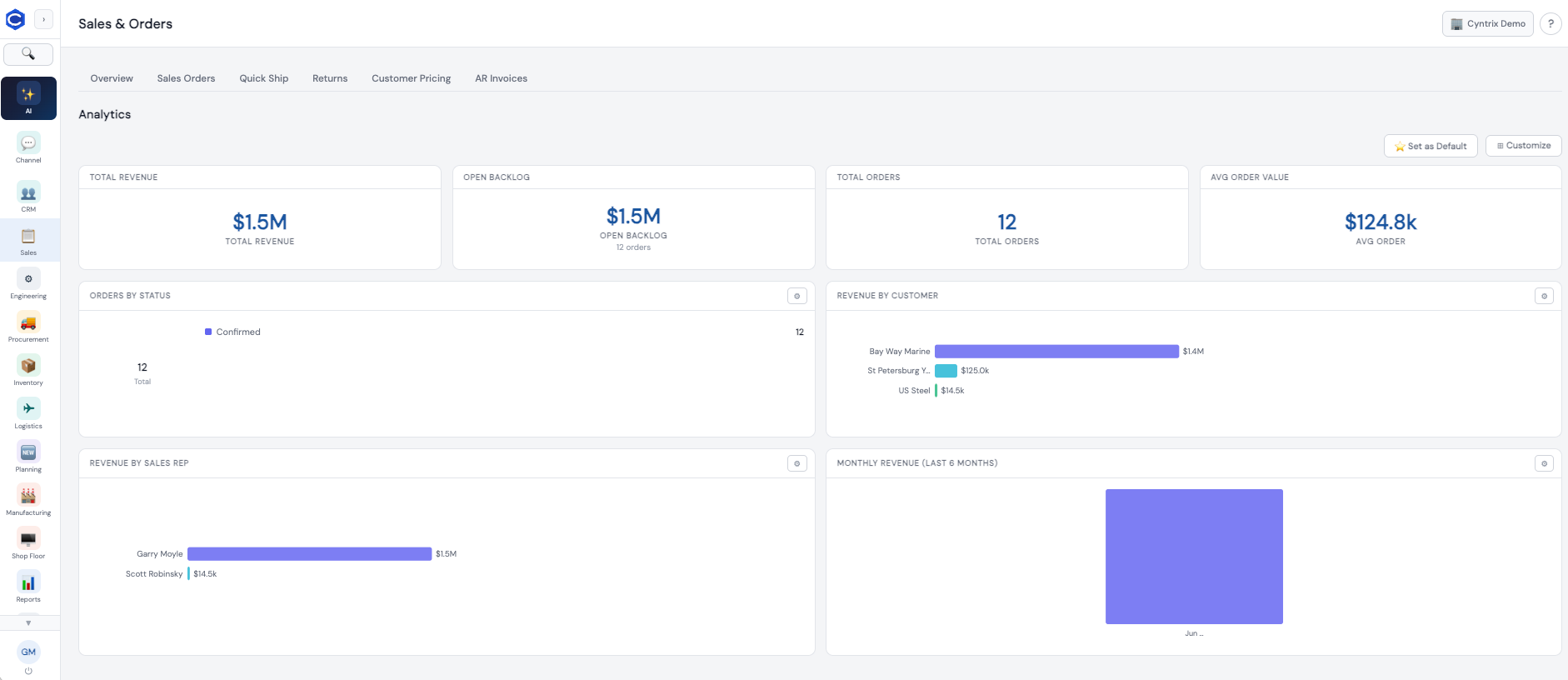
Sales & Order Management
Configurable quotes, sales orders, pricing rules, and fulfillment tracking connected directly to inventory and finance.
Inventory & Warehouse
Real-time stock visibility across locations with lot, serial, and bin tracking plus barcode-driven workflows.
Planning & Scheduling
Constraint-based scheduling that balances demand, capacity, and material availability so every job lands in the right order.
Manufacturing
Bills of material, routings, work orders, and shop-floor scheduling that scale from discrete to mixed-mode production.
Supply Chain & Purchasing
Demand-driven procurement, supplier management, and MRP that keep the right materials flowing at the right time.
Enterprise-grade capability, without the enterprise baggage
How CyntrixOne stacks up against traditional big-name ERP systems like Epicor, NetSuite, Microsoft, and Infor.
Epicor, NetSuite, Microsoft, and Infor are trademarks of their respective owners. Comparison reflects typical offerings and is provided for general guidance.
See CyntrixOne in action
Get a personalized walkthrough and a transparent quote. Start with one module or run your whole business — your call.